




Experimental Archaeology
What is experimental archaeology?
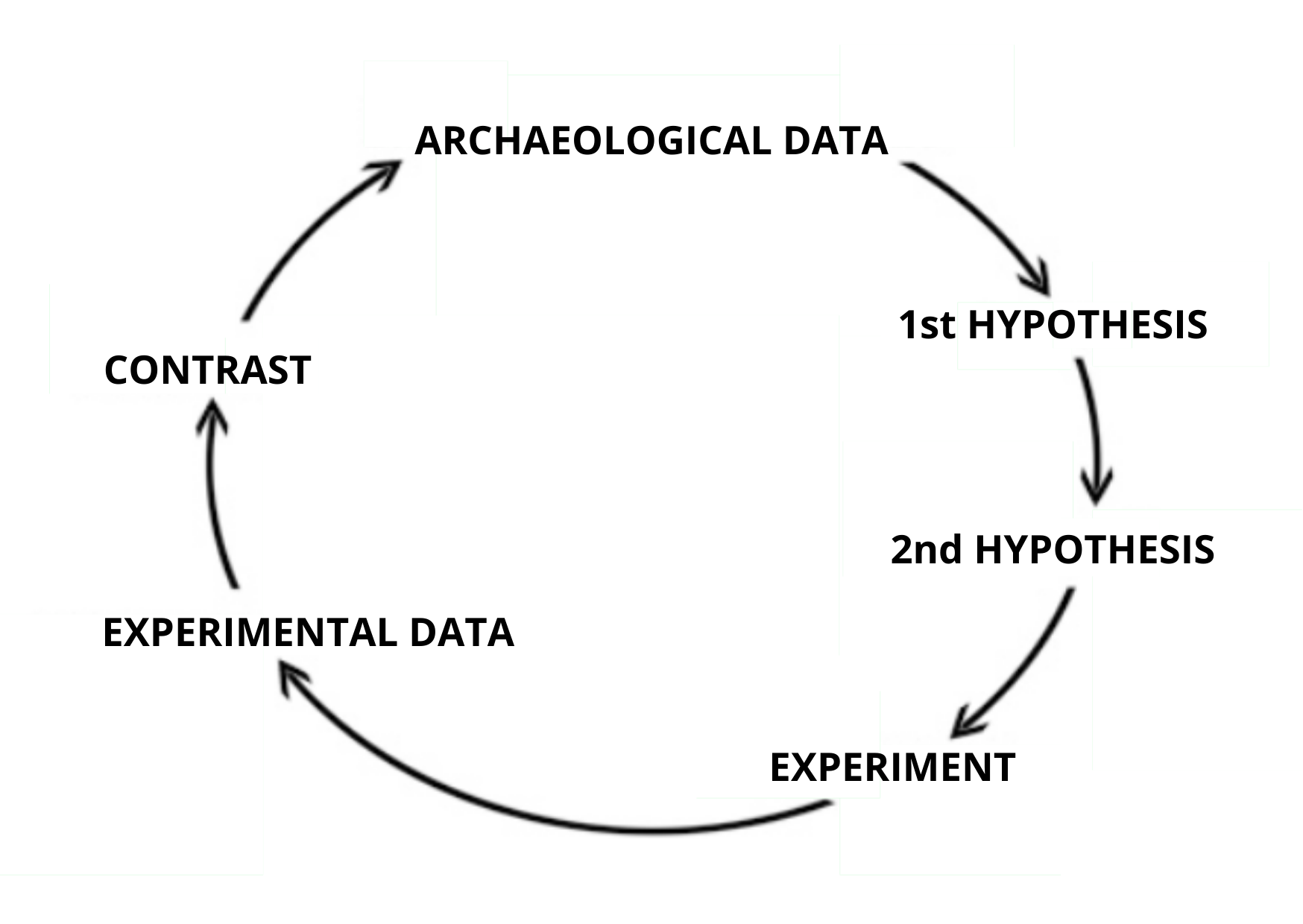
The purpose of experimental archaeology is to test hypotheses and theories provided by archaeological evidence, as well as possible interpretations of the function of a space, of a set of structures, or also of the relationship of the structure to its contents, which are generally not demonstrable. Thus, the experiment is a system by which a hypothesis can be verified, aimed in fact at understanding and learning about human activity.
The experimental process has a rigorous methodology and uses the strict standards of the science involved; so if the test relates to a structure, the experiment has to satisfy the architectural and technical requirements, and also has to be subject to the test of time, if as in this particular case the experiment relates to agriculture, the detail has to be acceptable to the agronomist and crop specialist.
Once the experiment has been completed, a comparison of the test results and the archaeological data is made. If there is a correlation, the hypothesis is valid, if not; the initial hypothesis must be rejected. The experimentation itself and its results can lead to the formulation of other hypotheses if the second possibility is reached.
The direct application of experimental archaeology as an empirical method was first applied in England by Ph.D. Peter John REYNOLDS, founder and director of the BUTSER ANCIENT FARM . This research centre, an open-air laboratory located in the countryside of Hampshire, allows you to visit and test in situ the constructions of round huts from the Iron Age, a Roman village, fields, and ancient livestock, all in-process and in active use.
In 1990, L’Esquerda began a direct collaboration with BUSTER ANCIENT FARM, which is continuing through a series of joint research projects. The system and method of experimentation are therefore the same as those used at BUTSER ANCIENT FARM.